

Expert Guide to Scarcity, Choice & the Production Possibilities Curve (PPC)
What is Scarcity?
Scarcity means
Human wants are unlimited, but resources are limited.
In other words,
People always want more goods and services than society has enough resources to produce..
In Simple words
Scarcity is the condition where
Resources are insufficient to satisfy all unlimited human wants.
or I can say
Scarcity means “There is not enough of everything for everyone.”
The four factors of production
Resources used to produce goods and services fall into four categories, which economists call the factors of production.
1 · Land
Natural resources : water, forests, oil, coal, rivers, minerals, farmland.
2 · Labour
Human effort : teachers, doctors, engineers, farmers, drivers.
3 · Capital
Man-made tools used to produce other goods : computers, factories, tractors, machines, buildings.
4 · Entrepreneurship
The ability to organize land, labour, and capital and take on risk : business owners, startup founders, small restaurant owners.
Scarcity exists because resources are limited but Human wants are unlimited.
So,
Unlimited Wants
Limited Resources
Therefore
Scarcity Exists.
Examples of Scarcity
Imagine There are 10 apples and 100 people. Can everyone get one?
No.
Some people won’t get apples.
That shortage exists because
the apples are scarce.
Scarcity vs Shortage
Scarcity
Scarcity is permanent because resources are always limited relative to wants.
Example:
There are only 24 hours in a day. Time is always scarce.
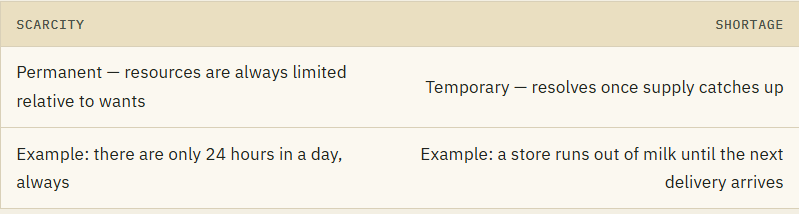
Shortage
A shortage is temporary.
Example:
A store runs out of milk because demand suddenly increased. Once more milk arrives, the shortage ends.
Scarcity Creates Choice
Because resources are limited, people must choose.
Examples:
- Study or play games?
- Buy a laptop or a phone?
- Build a hospital or a stadium?
- Produce more cars or more buses?
Choice exists because scarcity exists.
This leads directly to the next concept in economics: Choice.
What is Choice ?
Choice is the process of deciding how to use scarce resources among competing alternatives.
Or simply:
Choice means deciding between two or more alternatives because resources are limited.
In simple words
Choice means
“You cannot have everything, so you must decide.”
Why Does Choice Exist?
Choice exists because:
- Resources are limited.
- Human wants are unlimited.
Since we cannot satisfy every want, we must decide which wants to satisfy first.
The three characteristics of every choice
1 · Limited resources
Money, time, energy, skills, and raw materials are all finite : for a person, a firm, or a country.
2 · Unlimited wants
A better phone, a bigger house, higher grades, one more vacation : wants expand faster than resources ever can.
3 · Alternatives
Choice only exists when there is more than one option and they compete for the same resource : study or watch a show, but rarely both at once.
Choice always means trade-off
Whenever something is chosen, something else is given up.
A student who attends college full-time cannot simultaneously hold a full-time job the forgone alternative is the trade-off. This is the seed of the next concept in economics: opportunity cost.
Choice is the decision itself for example, going to college. Opportunity cost is what that decision gives up — the salary that could have been earned working instead.
Production Possibilities Curve (PPC)
What is The Production Possibilities Curve or What is PPC?
The Production Possibilities Curve (PPC), also called the Production Possibilities Frontier (PPF), shows:
The maximum combinations of two goods that an economy can produce using all available resources efficiently and existing technology.
in simple words
A PPC shows:
“What can an economy produce when all resources are fully and efficiently used?”
Why Do We Use Only Two Goods?
Real economies produce millions of products.
A graph cannot show millions.
Economists simplify by using only two goods.
Example:
Military Goods and Civilian Goods
Pizza and Burgers
Cars and Computers
Consumer Goods and Capital Goods
Shifts of the PPC
Outward Shift
The economy can produce more of both goods.
Reasons:
- Better technology
- More workers
- More capital
- More natural resources
- Improved education and skills
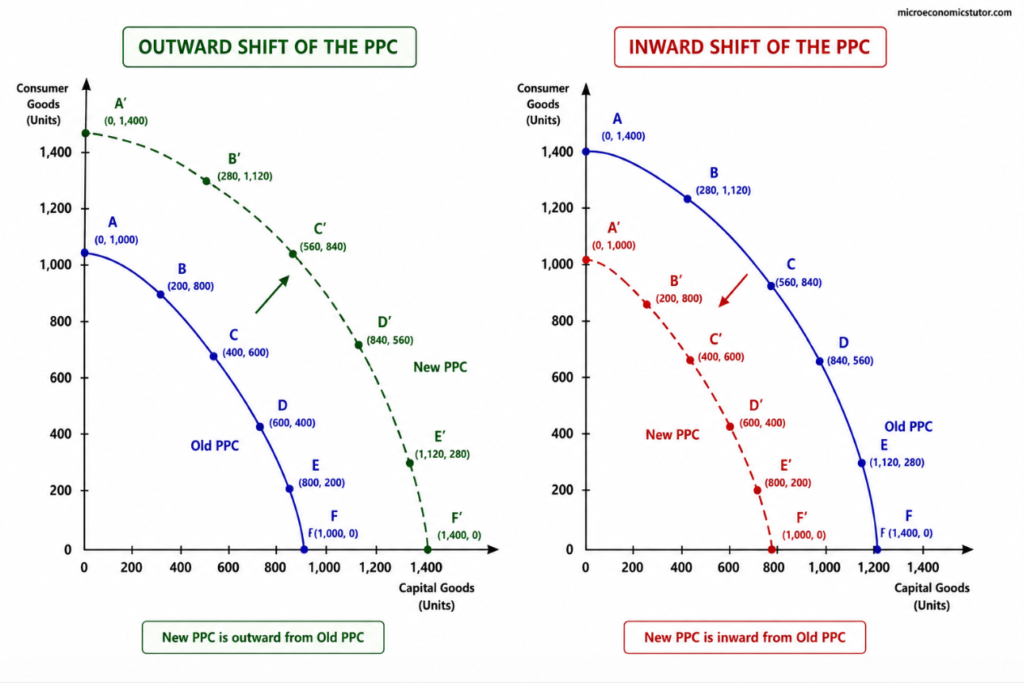
Inward Shift
The economy can produce less of both goods.
Reasons:
- War
- Natural disasters
- Loss of resources
- Disease
- Destruction of factories
Efficient, Inefficient, and Unattainable Points on PPF curve
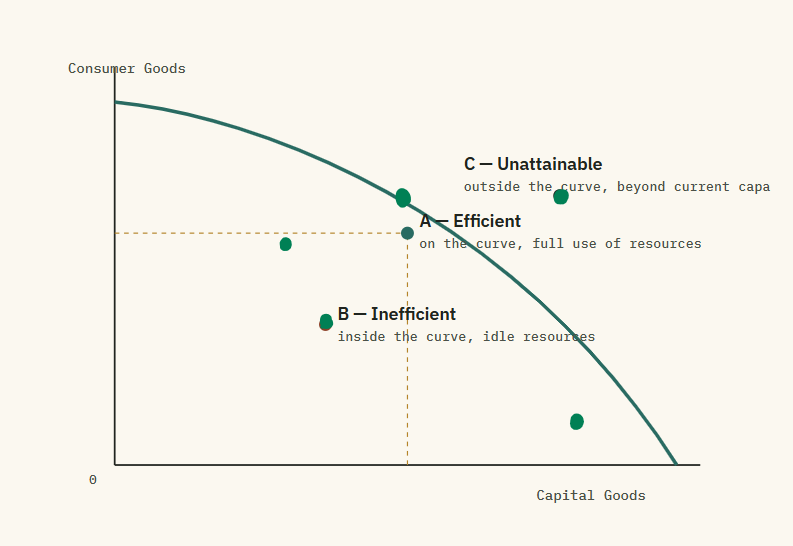
On the Curve – Efficient
Resources are fully employed.
Maximum production is achieved.
Inside the Curve – Inefficient
Some resources are unemployed or underused.
Examples:
- Unemployment
- Idle factories
- Empty farmland
Outside the Curve – Unattainable
Production beyond the current PPC is impossible with existing resources and technology.
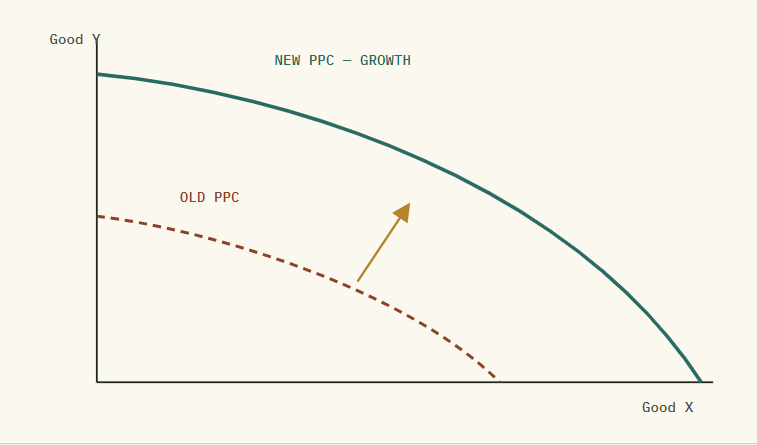
When the curve itself moves
The PPC is not permanent – it shifts when the underlying resources or technology change.
Important Practice Questions on Scarcity, Choice & PPCs
Scarcity
1. Define scarcity. Why is it considered the fundamental economic problem?
Scarcity is the condition in which limited resources are insufficient to satisfy unlimited human wants. It is the foundation of economics because it forces individuals, firms, and governments to make choices.
2. Why does scarcity exist even in wealthy countries?
Wealth increases available resources, but human wants continue to grow. Since wants always exceed available resources, scarcity remains.
3. Explain why scarcity is permanent but shortages are temporary.
Scarcity always exists because resources are limited relative to unlimited wants, whereas shortages occur temporarily when quantity demanded exceeds quantity supplied at the current price.
4. Can technological progress eliminate scarcity completely? Explain.
No. Technology expands production possibilities but cannot eliminate scarcity because human wants continue to increase.
5. Is time considered a scarce resource? Why?
Yes. Every individual has only 24 hours per day, making time limited and requiring choices about its use.
6. Explain the relationship between scarcity and opportunity cost.
Scarcity forces people to choose, and every choice involves giving up the next best alternative, which is the opportunity cost.
7. Why is money not considered capital in economics?
Capital refers to man-made resources used to produce goods and services, while money is simply a medium of exchange used to purchase capital.
8. If resources became unlimited while wants remained unlimited, would scarcity still exist?
No. Scarcity only exists because resources are limited relative to wants. Unlimited resources would eliminate scarcity.
9. Can an individual experience scarcity even if they are wealthy?
Yes. Wealth cannot overcome limited time, limited natural resources, or physical constraints.
10. Explain why air is generally not considered scarce but clean drinking water often is.
Air is abundant in most situations, while clean drinking water is limited relative to demand in many regions.
Choice
11. Define choice in economics.
Choice is the process of selecting among alternative uses of scarce resources.
12. Why does scarcity necessarily create choice?
Because limited resources cannot satisfy all wants, individuals and societies must decide which wants to satisfy.
13. Can there be choice without scarcity? Explain.
No. If resources were unlimited, everyone could have everything they wanted without making decisions.
14. Explain why every economic decision involves a trade-off.
Choosing one option requires sacrificing another because scarce resources cannot be used for multiple purposes simultaneously.
15. Why are trade-offs unavoidable in economics?
Since resources have alternative uses, allocating them to one activity prevents their use elsewhere.
16. Explain how governments face the problem of choice.
Governments have limited budgets and must decide how much to spend on healthcare, education, defense, infrastructure, and other priorities.
17. Explain how businesses experience economic choice.
Businesses must allocate limited labor, capital, and financial resources among competing projects and production decisions.
18. Why do economists avoid describing choices as “good” or “bad”?
Economics focuses on analyzing costs, benefits, and incentives rather than making moral judgments.
19. Explain the three fundamental economic questions every society must answer.
Every society must determine what to produce, how to produce, and for whom to produce because resources are scarce.
20. Why does choosing more of one product usually require producing less of another?
Resources are limited, so using them for one product reduces their availability for producing another.
Production Possibilities Curve (PPC)
21. Define the Production Possibilities Curve (PPC).
The PPC illustrates the maximum combinations of two goods an economy can produce using available resources efficiently and existing technology.
22. What economic concepts does the PPC illustrate?
The PPC illustrates scarcity, choice, opportunity cost, efficiency, unemployment, and economic growth.
23. Why does the PPC assume only two goods?
Using two goods simplifies analysis while demonstrating the fundamental trade-offs faced by an economy.
24. What does a point on the PPC represent?
A point on the curve represents efficient production where all available resources are fully employed.
25. What does a point inside the PPC indicate?
It indicates inefficient production caused by unemployed or underutilized resources.
26. What does a point outside the PPC represent?
It represents a production level that cannot currently be achieved with existing resources and technology.
27. Why is every point on the PPC considered efficient?
Because all available resources are fully and efficiently utilized to produce the maximum possible output.
28. Why are points inside the PPC attainable but inefficient?
The economy has enough resources to reach those combinations but is not using all resources effectively.
29. Why are points outside the PPC unattainable?
Existing resources and technology are insufficient to produce those output combinations.
30. What assumptions are made when constructing a PPC?
The model assumes two goods, fixed resources, fixed technology, full employment, and efficient resource use.
Opportunity Cost and PPC
31. How does the PPC demonstrate opportunity cost?
Moving along the PPC to produce more of one good requires giving up some production of another good.
32. Why does opportunity cost increase as production shifts along a bowed-out PPC?
Because increasingly specialized resources are transferred to activities where they are less productive.
33. Explain the Law of Increasing Opportunity Cost.
As more resources are devoted to producing one good, increasingly larger amounts of another good must be sacrificed.
34. Why are resources considered specialized?
Different workers, machines, and land are better suited to producing certain goods than others.
35. Under what condition would the PPC be a straight line instead of bowed outward?
When resources are perfectly adaptable and opportunity cost remains constant.
PPC Shifts
36. What causes an outward shift of the PPC?
Economic growth resulting from better technology, more capital, more labor, improved education, or additional natural resources.
37. What causes an inward shift of the PPC?
War, natural disasters, disease, resource depletion, or destruction of productive capacity.
38. Does inflation shift the PPC? Explain.
No. Inflation changes prices, not an economy’s productive capacity.
39. Why does technological improvement usually shift the PPC outward?
Technology enables more efficient production, allowing greater output with the same resources.
40. Can an economy move from inside the PPC to the curve without increasing resources?
Yes. Better utilization of existing resources increases efficiency without requiring additional resources.
41. Why is the PPC considered a model of economic efficiency?
It identifies the maximum output achievable when resources are fully employed and efficiently allocated.
42. Can an economy operate beyond its PPC in the long run?
Only if the PPC shifts outward through economic growth, technological progress, or increased resources.
43. Why is unemployment represented by a point inside the PPC rather than on the curve?
Unemployment means some resources are idle, preventing maximum production.
44. Explain why economic growth differs from movement along the PPC.
Movement along the PPC reallocates existing resources, while economic growth expands productive capacity and shifts the entire curve outward.
45. If all resources suddenly became twice as productive, what would happen to the PPC?
The PPC would shift outward because the economy could produce more of both goods.
46. Can increasing production of one good ever increase production of another without shifting the PPC?
No. Along a given PPC, producing more of one good always requires sacrificing some of the other due to scarcity.
47. Why does the PPC illustrate the concept of choice better than a simple table?
The graph visually shows trade-offs, efficiency, opportunity cost, unattainable production, and economic growth.
48. Why is the PPC one of the most important models in microeconomics?
It integrates multiple core concepts: scarcity, choice, efficiency, opportunity cost, trade-offs, and growth into a single analytical framework.
49. How does the PPC help policymakers make economic decisions?
It illustrates the trade-offs involved in allocating limited resources among competing priorities such as healthcare, education, and defense.
50. Explain why every economy, regardless of its level of development, faces the PPC constraint.
Every economy has finite resources and technology at any point in time, making trade-offs unavoidable even as productive capacity differs across countries.
writen by Miss MBA Tutor
[…] Scarcity and Opportunity Cost: The Price Tag Nobody Sees […]