

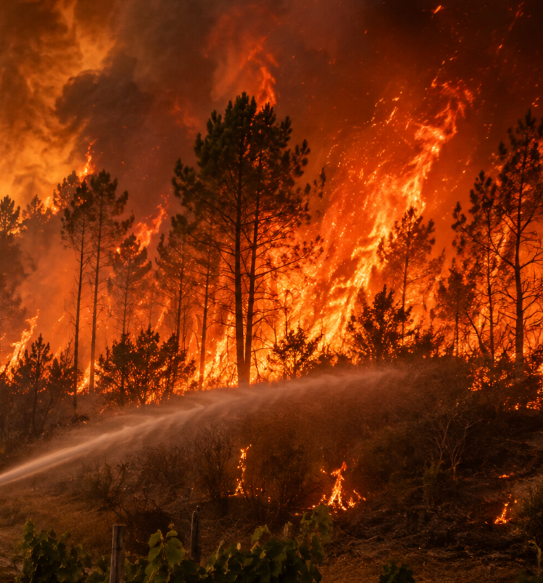
Bordeaux Wildfires : When news broke that wildfires were closing in on Bordeaux, wine buyers around the world feared the 2026 vintage had been destroyed.
The vineyards themselves were largely untouched.
That gap, between what people feared and what had actually happened, is exactly where microeconomics begins.
This July, wildfires tore through southern France and Spain. It came during one of the region’s worst heatwaves in years. Over 300,000 people were evacuated. Homes were lost. A life was lost in Valencia. This is, first and always, a human story.
But underneath it sits a near perfect case study in how markets actually behave. Not the textbook version. The real one, happening in real time, to a real industry. This article explains the Bordeaux wildfires using real microeconomics concepts including supply shocks, scarcity, opportunity cost and market expectations.
Why the Bordeaux Vineyards Escaped Immediate Damage
As fires burned west of Bordeaux, worried collectors started calling. Wine expert and tour guide Nicolle Croft became an unofficial hotline. People from around the world wanted to know one thing. Was the harvest ruined?
Her answer was calmer than the panic suggested. At the time of reporting, there was no evidence of significant damage to the vineyards. And even if smoke had drifted over them, July grapes are not developed enough to absorb much of it.
Winemakers call this risk smoke taint. Smoke compounds settle into the grape skin. They change the flavor, usually for the worse. But grapes only become truly vulnerable after a later stage called veraison, when the berries soften and start building sugar. Harvest in Bordeaux does not begin until early September. The real risk window had not opened yet.
Economics takeaway: A shock does not do the same damage every time. What matters just as much as the size of the event is where the business sits in its production cycle when the event hits.
Why a Supply Shock Depends on Timing, Not Just Size
At first glance, this looked like a classic supply shock. Fires, droughts, wars, and factory accidents all reduce how much of something can be produced. When supply drops and demand stays the same, prices are expected to rise.
But look closer. Supply had not actually fallen yet. Expectations had.
Timing changes everything. If this same fire had reached Bordeaux in late August, days before harvest, the story would be different. Mature grapes soak up smoke far more easily than young ones. One month later, the same fire could have meant real financial loss instead of a scare.
This is not unique to wine. A drought hurts wheat more during flowering than during early planting. A factory fire costs more in the weeks before a product launch than during a slow season. Before reacting to any disaster headline, ask this first. Not just how big is the damage. When exactly did it happen?
Scarcity and Opportunity Cost: The Price Tag Nobody Sees
Thousands of firefighters were deployed across France and Spain. Germany sent helicopters. Water bombing planes flew for days without a break. Roughly 30 fires burned in southwestern France at once.
None of this was unlimited. France could not send one helicopter to two fires at the same time. Every crew sent to Gironde was a crew not available somewhere else. This is scarcity in its purest form.
Scarcity is also the reason opportunity cost exists. Opportunity cost is the value of the next best option you gave up to do what you actually chose. Every euro spent on emergency shelter is a euro not spent on a school or a hospital. Every helicopter sent to France was not doing something else in Germany.
It sounds almost too simple to matter. It is one of the most underused ideas in daily life. Every choice carries an invisible twin: the thing that did not get chosen.
Market Expectations: Reacting Before the Facts Arrive
At the time of reporting, there was no evidence of significant damage to the vineyards. Yet Croft’s phone did not stop ringing.
Markets rarely wait for confirmed facts. They react to expectations. If enough buyers believe a shortage is coming, prices and orders can shift before a single fact is verified. Buyers were not responding to what had happened. They were responding to what they feared might happen.
This connects to a field called information economics. It studies how markets behave when information is incomplete or unevenly distributed among market participants. Wine collectors calling from around the world did not see the vineyards. They saw headlines. So they acted on those instead.
Companies in reputation sensitive industries, wine, luxury goods, tourism, spend real money on communication in moments like this. Not because the product changed. Because expectations moved before the facts did.
Think Like an Economist
A few lines worth keeping somewhere you’ll actually see them again.
Disasters do not destroy value evenly. They destroy it at whatever point in the cycle they happen to strike.
Markets move on belief before they move on proof.
Every choice is really two choices: the one you made, and the one you gave up.
Scarcity is not a flaw in the system. It is the reason the system exists at all.
Coming in the Next Article
This is only half the picture. In the next piece, we’ll look at what happens if prices actually do rise: why some Bordeaux buyers won’t switch to another wine no matter the cost, why some wineries could quietly profit while others lose out, and why insurance companies are already pricing in a future with more fires, not fewer.
FAQ
What is smoke taint?
A wine fault caused by smoke compounds absorbed through grape skins, usually after the grapes soften during veraison. It can leave wine with an ashy or burnt flavor.
Why do markets react before facts are confirmed?
Because prices move on expectations, not just verified outcomes. When information is incomplete, buyers often act on fear of a bad outcome rather than waiting to confirm it.
How does opportunity cost apply to a natural disaster?
Every resource used in an emergency response could have been used somewhere else. That forgone alternative is the opportunity cost of the response.
Sources
- CNN: France and Spain wildfires live updates, July 27, 2026
- CNN: France and Spain wildfires live updates, July 26, 2026
- CNN: Europe wildfires force over 250,000 evacuations, July 25, 2026
- The Drinks Business: Wildfires threaten wineries as blaze nears Bordeaux
- Wine-Searcher: Vintage Fears as Bordeaux Burns
Amazing !