AP Microeconomics · Study Guide
AP Microeconomics
Advanced Placement AP Microeconomics is a first-level course in microeconomics at a college level, designed by the College Board. It’s built for high school students who want to understand economics at the university level before they get there. Unlike an introductory economics course, AP Microeconomics focuses only on how individuals, households, consumers, business firms, and markets as a whole decide what to do with a limited amount of resources.
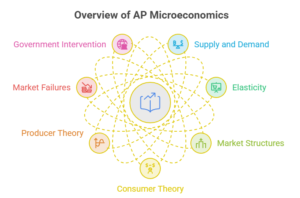
Course Units
AP Microeconomics Course Units
The AP Microeconomics curriculum is divided into six units. Every topic below is a link — add your own page URL to each one to build out a full AP Microeconomics topic library.
Unit 1
Basic Economic Concepts
Main Topics
Students Learn
- Why scarcity exists
- How choices involve trade-offs
- Why opportunity cost matters
- How countries benefit from trade
- Efficient resource allocation
Unit 2
Supply and Demand
Main Topics
Students Learn
- How prices are determined
- Why equilibrium occurs
- How governments affect markets
- Deadweight loss
- Tax incidence
Unit 3
Production, Cost and the Perfect Competition Model
Main Topics
Students Learn
- Firm decision making
- Cost curves
- Profit calculation
- Efficient production
Unit 4
Imperfect Competition
Monopolistic Competition
Students Learn
- How firms with market power behave
- Pricing strategies
- Strategic decision-making
Unit 5
Factor Markets
Topics
Students Learn
- How workers are hired
- Wage determination
- Resource allocation
Unit 6
Market Failure and Government Intervention
Externalities
Government Policies
Information Problems
Students Learn
- Why markets sometimes fail
- Government solutions
- Efficient resource allocation
Frequently Asked Questions
AP Microeconomics FAQ
What is AP Microeconomics?
AP Microeconomics is a College Board Advanced Placement course that studies how individuals, households, consumers, business firms, and markets decide how to allocate limited resources — the building blocks being scarcity, choice, and opportunity cost.
How many units are in AP Microeconomics?
Six: Basic Economic Concepts, Supply and Demand, Production and Cost, Imperfect Competition, Factor Markets, and Market Failure and Government Intervention.
What topics does AP Microeconomics cover?
Everything from scarcity, the production possibilities curve, and comparative advantage to supply and demand, market structures like monopoly and oligopoly, factor markets, and externalities — see the full topic list in each unit above.
Is AP Microeconomics different from a regular economics class?
Yes. Unlike an introductory economics course, AP Microeconomics only studies decisions at the individual, household, firm, and market level rather than the whole economy.